
Predictive logistics: the algorithm at the service of cash flow
In a small business, cash rarely dies all at once: it evaporates silently on shelves and in the back of vans. Cross-checking your sales, quotes and supplier lead times finally lets you order at the right time, without a bloated system.
In short
- Dormant stock is cash tied up by the fear of running out.
- Fixed thresholds ("reorder at 5") ignore seasonality, open quotes and supplier lead times.
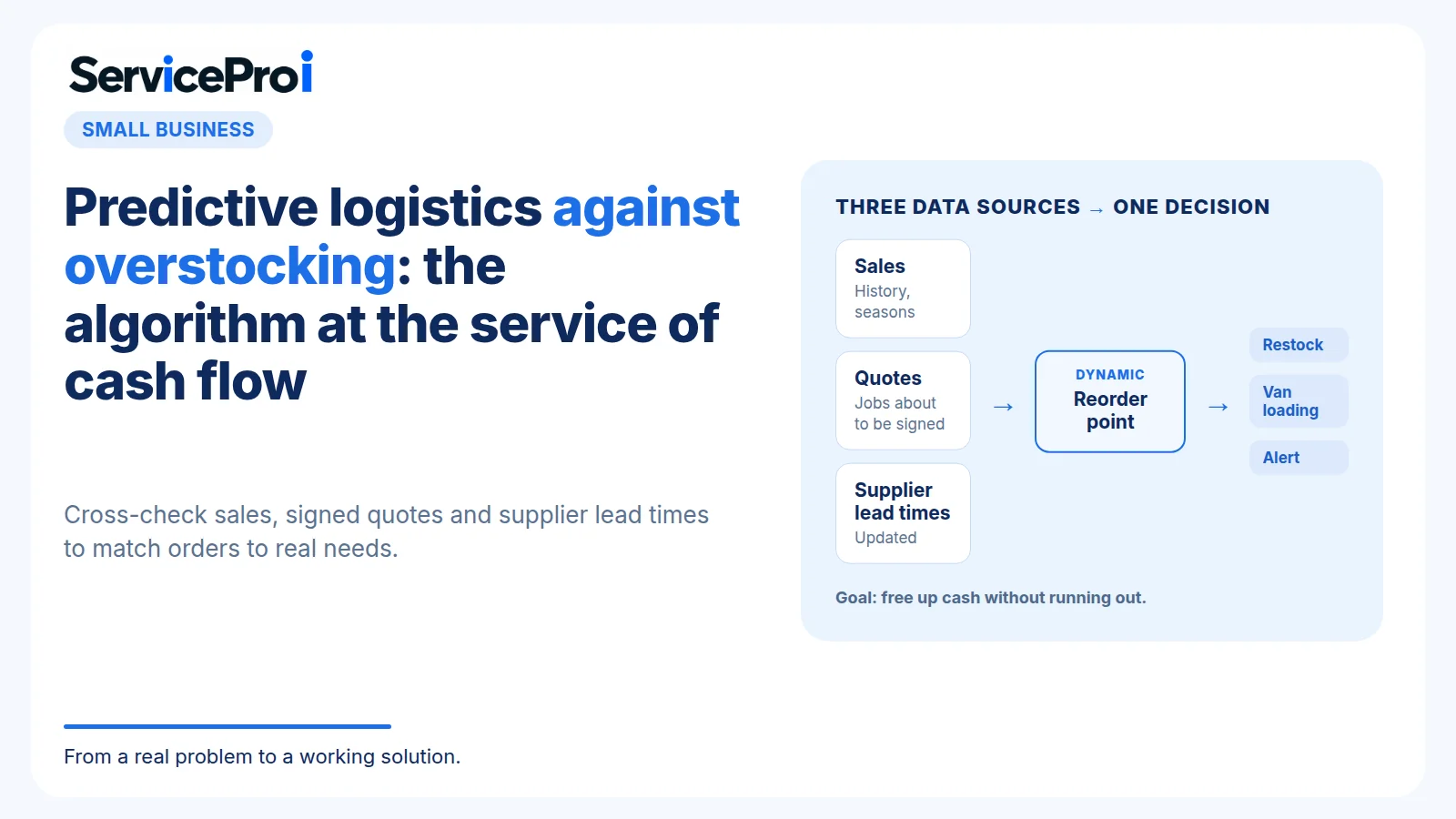
- Cross-checking three pieces of data you already have is enough to calculate a dynamic reorder point.
In a small business, cash does not always die from a dramatic twist or a catastrophic unpaid invoice. Most often it evaporates silently, on warehouse shelves or in the back of a service van.
Boxes of supplies ordered "just in case", raw materials tied up as a precaution, dormant spare parts losing value as standards change: physical stock is the accounting expression of the owner's doubt.
For decades, small shops and trades have navigated between two hazards: stock-outs, which send customers to the competitor, and overstock, which suffocates cash flow. Large retailers solved the equation with statistical forecasting. For a small business, custom predictive analysis finally makes this industrial privilege accessible, without buying bloated software.
The myth of guesswork and the false security of fixed thresholds
Restocking in a small business often relies on static thresholds decided on a quiet day: "as soon as five units are left, we reorder". This method ignores reality: seasonality, changing supplier lead times, local trends, fluctuating raw material prices.
The result: the business reorders too early before a quiet period, tying up cash just when it needs it most, or too late just before a peak, with stress and delays as a consequence.
The predictive approach is not about reading the future in a crystal ball, but about cross-checking three sources of data that already exist, often in separate silos:
- the history of actual sales;
- the book of quotes about to be signed;
- suppliers' updated restocking lead times.
If this information lives in separate files, that is the first job: see Connect your tools.
Dynamic purchasing: reconciling the algorithm and cash flow
Bringing predictive logic into the running of a small business changes how operations are managed:
- The dynamic reorder point: instead of a fixed threshold, the system recalculates the minimum quantity needed every day, based on the pace of sales over the same period in previous years and the jobs signed on the schedule.
- The pre-filled order: as the critical point approaches, the system prepares the purchase order with the right supplier, at the best price, taking free-delivery thresholds into account. The manager only has to approve it in one click.
- Loading the vans: for service and building businesses, analysing the next day's jobs means the right parts can be loaded into each vehicle the evening before. No more trips back to the depot, which waste fuel and working hours.
The good news: this kind of calculation usually comes down to simple statistics and automation, not expensive generative AI.
Taking back control of your cash
Predictive logistics is the armed wing of financial management. It is a reminder of a basic rule, too often forgotten under the weight of everyday work: a euro tied up in useless stock is a euro that can no longer be used to invest, to pay for work or to cope with the unexpected.
By handing the rigour of the calculation and restocking alerts to an automated tool, the owner no longer lets fear of running out dictate their stock policy. They turn their physical reserve into a controlled just-in-time flow, and free their cash for what really matters: the long-term survival and independence of their business.
Further reading
- Custom software for a small business: when a tailored tool makes sense
- The paperless illusion: handing the admin burden to the algorithm
Is your stock tracked in a spreadsheet that never warns you in time? Describe your situation: we will look at what can be calculated automatically.