
Survival marketing: automate the form, never the substance
Bland posts, rocket emojis and pompous adjectives: handing your communication to a generic AI destroys in a few lines the trust built up over years. The right method: feed in real facts, automate the formatting, keep your hand on the "Publish" button.
In short
- An unconfigured AI produces the most average text possible: background noise.
- The right fuel for small business marketing: real facts (finished jobs, solved cases, testimonials).
- Automation prepares, the human approves: never publish without a read-through.
You only have to scroll through LinkedIn or open your inbox to see the scale of the disaster. A tidal wave of bland prose, speckled with rocket emojis and pompous adjectives ("disruptive", "game-changing", "holistic"), is flooding communication channels.
In the name of "doing marketing", thousands of small businesses hand the writing of their posts to generic, unconfigured AI. The result: interchangeable prose that betrays its robotic origin on first reading, and destroys in a few lines the credibility built up over the years.
For a small business, whose first asset is local trust, this algorithmic mush is poison.
The trap of constant, low-cost presence
Digital marketing gurus keep saying you need to post three times a day on four networks to exist. Without the time or budget of a large group, the small business owner takes the easy way out: they ask a consumer AI to "write an engaging post about their business".
The problem: these language models are designed to produce the most probable text, and therefore the most average and the most consensual. They stick writing stereotypes from elsewhere onto local economic realities.
Thinking it is automating its visibility, the small business automates its invisibility: it becomes background noise that prospects' brains have learned to ignore.
The hybrid workflow: raw facts, automated form
Useful marketing for a small business does not rest on pub philosophy, but on showing real facts: a finished job, a technical problem solved, a custom-made part, an authentic customer testimonial.
Smart automation does not invent the story; it speeds up how it is shaped:
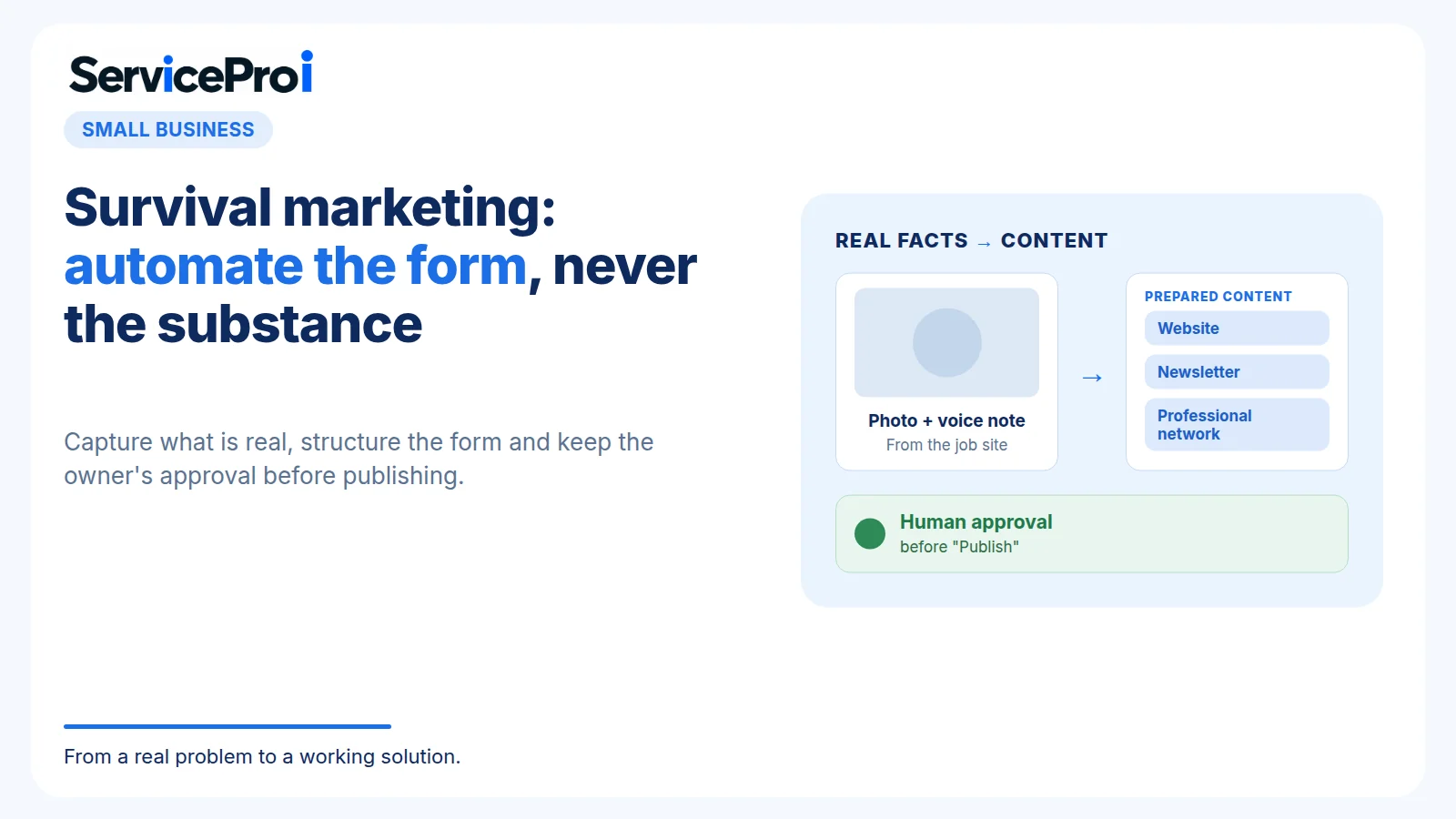
- Capture at the source: the owner or the technician takes a photo on site and dictates a thirty-second voice note ("Replaced a 1980s boiler with a hybrid system, town X, estimated 30% saving on the bill").
- Structuring: the workflow picks up this raw material, applies the company's tone rules (trade vocabulary, no hollow jargon) and prepares the post as well as the "customer case" page for the website.
- Targeted versions: from this concrete case, the system prepares a newsletter for existing customers and a short post for the professional network, without ever inventing a single fact.
That is exactly the principle of document automation: producing faster from information that already exists.
Human approval as a safety lock
No commercial content should leave the business without the owner's approval. Automation stops at the threshold of the "Publish" button.
The ideal workflow prepares the post in a single dashboard, or sends it as a notification to the owner's phone. All they have to do is read the draft in a few seconds, correct a technical term if needed, and approve.
The same logic applies to email prospecting: consent rules apply whether a message is written by hand or prepared by a machine. In Europe, that means the GDPR and the national e-privacy rules.
By automating most of the tedious work of formatting and distribution while keeping 100% control over the substance, the small business escapes soulless industrial communication. It speaks less often, but it speaks right, in its own voice.
Further reading
- Digital sovereignty: freeing small businesses from subscription serfdom
- Automated customer service: availability without the chatter
Want a workflow that turns your job photos into publishable content? Let's talk.