
Building a solution starts with understanding the problem
Before choosing a tool, an automation or an AI, you need to understand what is really happening. That is how I work at ServiceProI: from a real problem to a working solution.
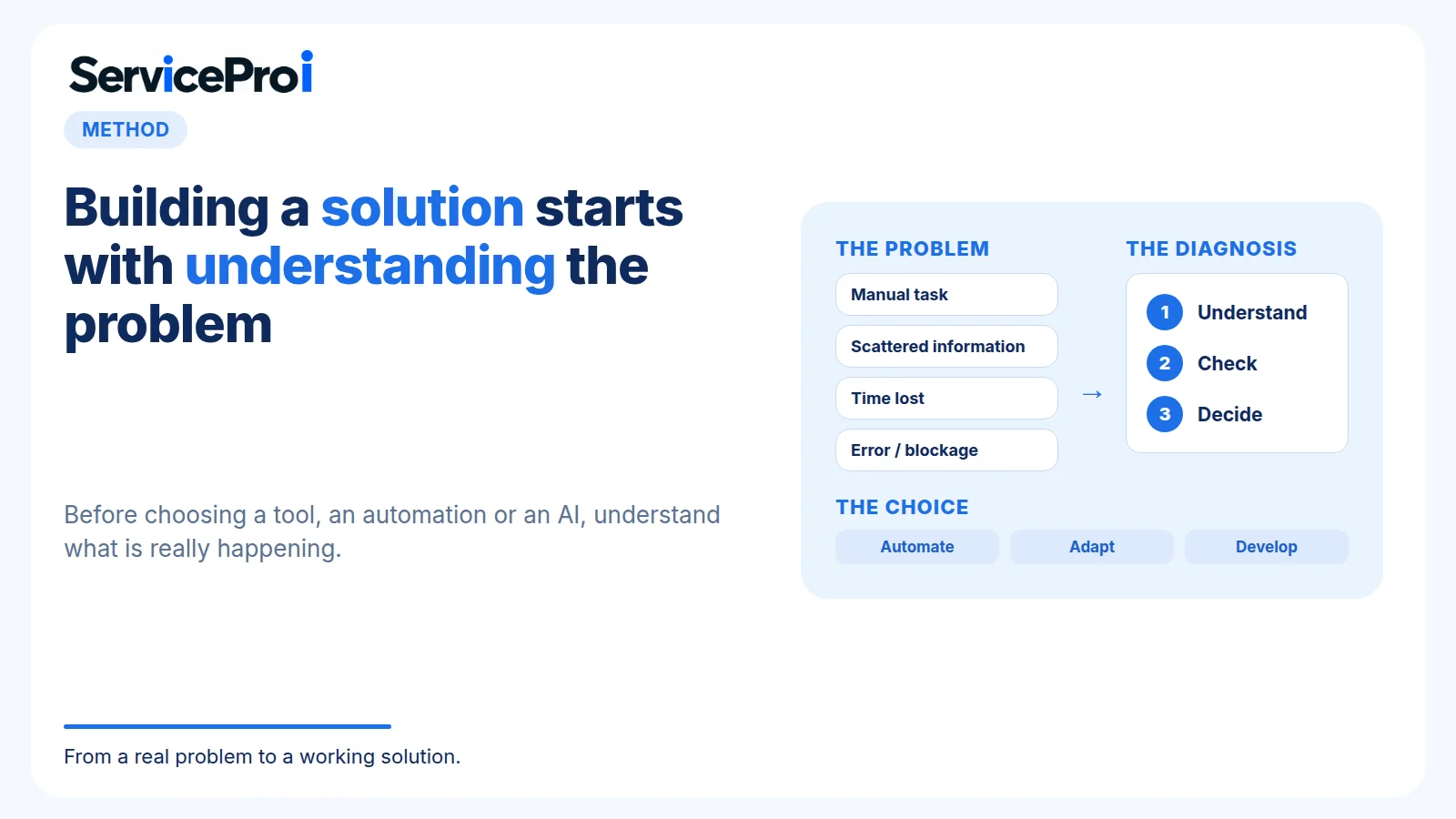
At ServiceProI, I try to resist a fairly common temptation: looking first at what technology can do.
There is AI.
There is automation.
There is software, APIs, dashboards, assistants, integrations…
And then there is your problem.
The little thing that makes you lose time every day. The file that has to be redone by hand. The information that exists somewhere, but that nobody can find when they need it. The process that works, admittedly, but only if the right person is there at the right time.
That is usually the best place to start.
"We should automate that"
We can all understand that sentence.
And it can be perfectly relevant.
But it is not a solution yet.
Automate what exactly?
At what moment?
Based on what information?
To get what result?
And above all: why is this step done this way today?
These are not very spectacular questions.
They probably won't make a futuristic artificial intelligence appear on your screen.
But they sometimes avoid building a bloated system to solve a problem that, in the end, fitted in a single button.
Understanding what really happens
So I start from how things really work.
Not only from what you would like to get at the end, but also from what happens today: the steps, the people involved, the information used, the tools, the constraints and the moments where things get stuck.
Because between:
"I'd like to automate this task"
and:
"Here is exactly what should happen, under what conditions, with what information and for what result"
there is sometimes a little way to go.
That is precisely the way I try to clear.
The aim is to move from understanding to analysis, then from analysis to a solution designed for the real need.
What if AI is not the answer?
It is a possibility.
But it is not an obligation.
A repetitive task may call for simple automation.
A problem with information flow may need an integration between several tools.
A specific need may justify developing a business tool.
And in some cases, yes, artificial intelligence brings something that other solutions cannot achieve as simply.
Automating a task, automating information processing or building a business tool do not answer the same situations.
So technology comes after understanding the problem.
Custom doesn't necessarily mean building everything
That is another important point.
"Custom" does not necessarily mean "I'll build you a brand new piece of software".
If an existing tool does the job properly, you might as well use it.
If it can be adapted or connected to the way you work, you might as well start there.
And if something is really missing, only then do we consider building it.
It sounds obvious.
And yet, in digital as elsewhere, it is easy to fall in love with the solution before the problem has even been properly stated.
It's human.
But it can be expensive.
So, what does ServiceProI do?
I support small businesses, SMEs and freelancers facing real digital problems: manual tasks, information processing, processes that are too heavy, or the need for specific business tools.
The approach starts with a fairly simple question:
"What is really causing you a problem?"
Only then comes the question of technology.
- Automation?
- Integration?
- Development?
- AI?
The choice follows the problem.
Not the other way round.
In the end, it is quite close to traditional craftsmanship: you don't take out the whole toolbox before looking at what needs fixing.
From a real problem to a working solution.
To go further: describe your situation or see my packages and prices.
Read also: Got an app idea? The 5 questions to ask yourself before you start · A digital solution does not start with technology