
The paperless illusion: handing the admin burden to the algorithm
The promised "paperless office" has become a double digital burden: you still have to keep the receipt, but also scan it, rename it, file it and upload it to three portals. Useful automation is not there to show off: it gives the owner their evenings back.
In short
- Many "AI accounting" apps do little more than character recognition, billed by the month.
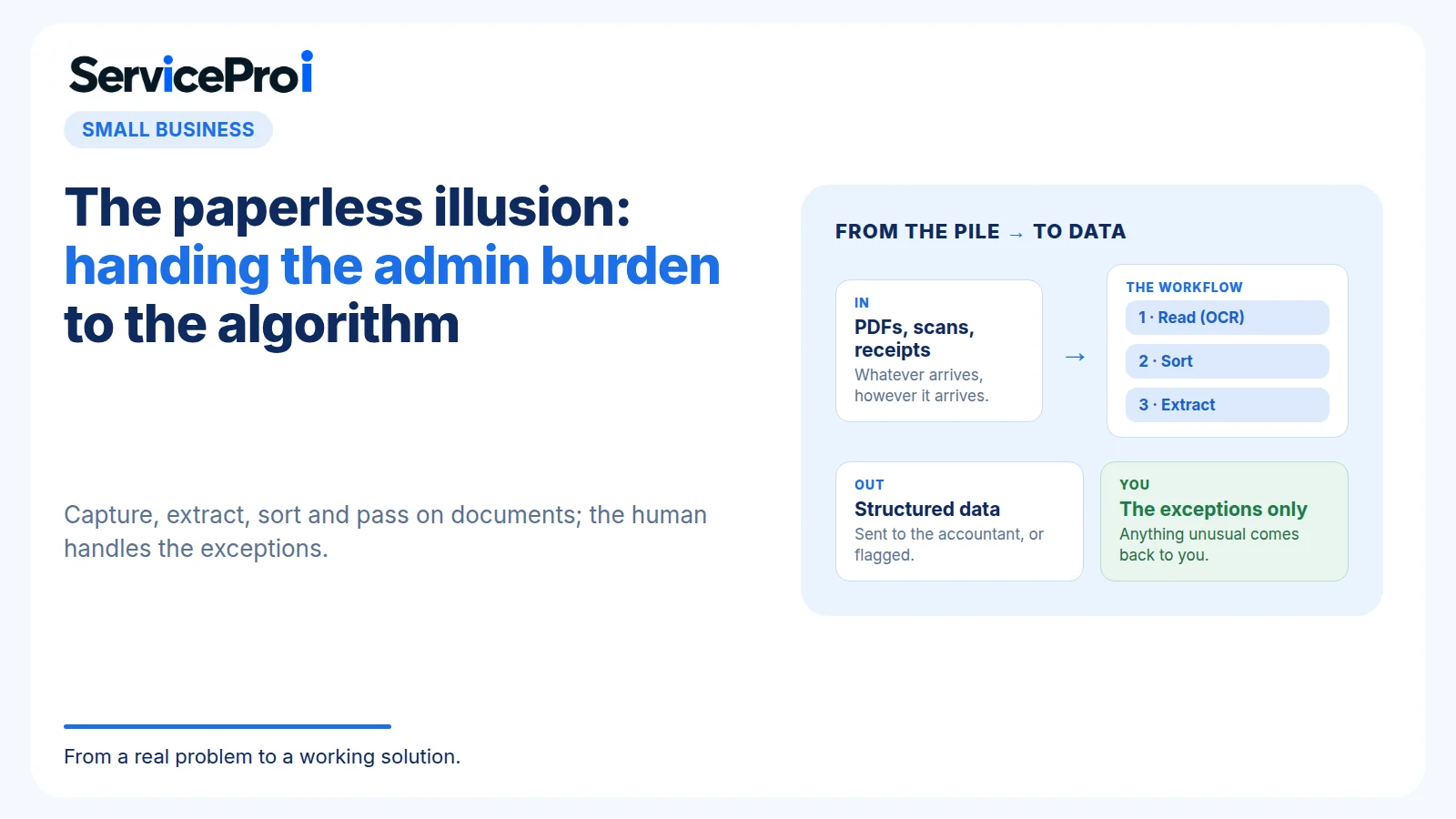
- Useful automation is discreet: it captures the document, extracts the data, files it.
- The goal: give the owner back 5 to 10 hours a week.
Every Sunday evening, in thousands of workshops and shops, the same ritual plays out. A tradesperson or small business owner, lit by the office strip light, tries to match a crumpled till receipt with an obscure line on a bank statement.
We were promised the "paperless office"; what we mostly got was the double digital burden. The paper is still there, but now it has to be scanned, named according to an absurd naming scheme, filed, then uploaded to several portals with interfaces from another century.
The owner no longer spends their time creating value or finding customers: they have become an unpaid data-entry clerk. This is where automation stops being an engineering topic and becomes a matter of mental survival.
The trap of the algorithmic gadget
The modern reflex is to jump on the latest fashionable app, billed at fifteen euros per user per month, which promises to "revolutionise accounting with AI". In reality, many of these over-packaged platforms do little more than optical character recognition (OCR), while collecting your spending habits along the way.
You have to separate the gadget from the plumbing. Asking a language model with billions of parameters whether a tank of fuel is a business expense is absurd. Useful automation does not shine through complexity, but through discretion: a well-configured flow intercepts the document at the source, extracts the key information (amount before tax, VAT, company number, date) and pushes it into the accounting tool without human intervention.
E-invoicing changes the game
The subject is becoming urgent. In France, where I am based, electronic invoicing between businesses is being rolled out from 1 September 2026, starting with the obligation to be able to receive electronic invoices, and many European countries are moving the same way.
The good news: an electronic invoice is structured data, much easier to process automatically than a scanned PDF. It is the right time to build workflows that take advantage of it, rather than carrying on retyping everything.
Matching, filing, chasing: the silent machinery
AI applied to bookkeeping makes sense when it acts within a closed, predictable workflow:
- Document intake: rather than piling up orphan PDFs, the system identifies the nature of each document as soon as it arrives by email or scan, and files it in the right place.
- Automated bank reconciliation: matching bank transactions with invoices sent or received happens in the background. Only anomalies are flagged, instead of making the owner check 100% of the lines.
- Autonomous reminders: chasing unpaid invoices does not require the creativity of a writing robot, but a graduated scenario tailored to each customer's history, in line with the payment terms and late-payment rules that apply in your country.
Many of these documents arrive by email: that is often where to act first.
Winning back the only non-renewable resource: time
The goal is not some abstract technological purity, but to give the owner back five to ten hours a week. Hours that will not be spent staring at colourful dashboards, but running the business.
Putting the algorithm to work on low-level repetitive tasks means refusing to let admin eat into the owner's private life. AI becomes a sanitary filter against bureaucracy: it absorbs the complexity upstream so that the human only deals with decisions.
Further reading
- Automatic document extraction: sorting invoices, quotes and letters without retyping
- Automated customer service: availability without the chatter
- Predictive logistics: the algorithm at the service of cash flow
Want to know which admin tasks to automate first? Describe your situation and we will look at it together.