
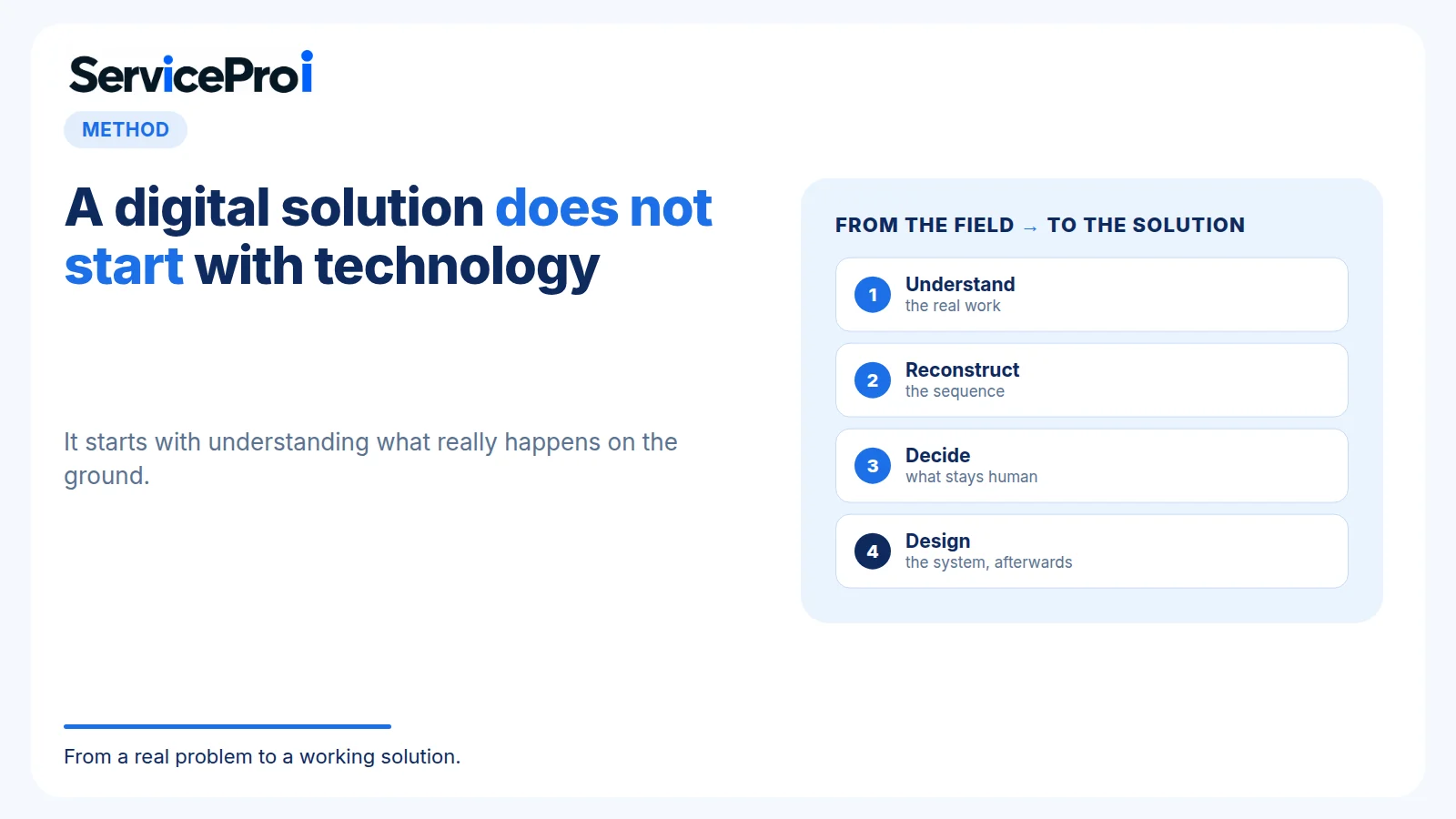
A digital solution does not start with technology
Between what an organisation thinks it does, what it writes in a specification and what the person handling a file actually does, there is a gap. That is where design work begins.
In short
- Before choosing a tool or an AI, I try to understand the real work, not the one in the specification.
- Automating is not removing the human: you automate what comes before the decision, not the decision itself.
- This method also changes the pricing: I price what really needs to be built, and I can say no.
It starts with understanding what really happens on the ground.
There is a question I ask before starting to develop anything:
"What really happens today?"
Not:
"What tool do you want?"
Not:
"Which AI would you like to use?"
And not even:
"Which feature should be added?"
I first want to understand the real work.
Because between what an organisation thinks it does, what it describes in a specification and what really happens when a person deals with a situation, there is often a gap.
That gap is precisely where the design work lies.
I start from the problem, not the solution
Take a very simple example.
A non-profit tells me:
"We waste a lot of time preparing our grant applications."
The immediate answer could be:
"You need to automate the writing with an AI."
But that is not a solution yet.
Before developing anything, I try to understand the process.
Which documents are used?
What information has to be found?
Which pieces are already available?
Which ones have to be looked for?
Who checks the data?
At what point does a person have to make a decision?
What absolutely has to stay under human control?
Sometimes we then discover that the problem is not really the writing.
It may be about finding information, filing documents, checking, passing things between several people, or simply piecing together a history.
The right tool depends on the problem actually encountered.
I reconstruct the real sequence
I take a concrete situation and walk through it in order.
A request comes in.
→ A person opens the file.
→ They look for a piece of information.
→ The information isn't available.
→ They look through several documents.
→ A piece of data has to be checked.
→ They ask someone for confirmation.
→ A decision has to be made.
→ Processing can continue.
This sequence makes it possible to distinguish:
- what can be handled directly;
- what needs a search;
- what needs checking;
- what needs another person to step in;
- what needs a decision.
And these differences completely change the solution to design.
I don't try to automate what shouldn't be
Automating is not removing the human.
If a step needs a decision, the aim is not necessarily to have a machine make that decision.
Instead, you can automate what comes before:
- gathering the information;
- finding the documents;
- preparing a summary;
- flagging an anomaly;
- presenting what is needed for the decision.
The human then steps in at the right place.
Technology does not replace the way the business works.
It improves it where that really makes sense.
Only then do I design the system
Once the way things work is understood, I can start designing.
Problem identified
→ scattered information
Need
→ quickly find the relevant information
Possible solution
→ specialised document search engine
Additional need
→ avoid answers based on outdated documents
Solution
→ verification and traceability mechanism
Human need
→ keep the final decision
Solution
→ human approval built into the process
This takes us from:
"We need an AI"
to:
"Here is precisely what the system must do, what it must not do and when a person must step in."
This method also changes the pricing
Once the way things work is broken down, I can identify the real units of work:
- analysing the sources;
- structuring the data;
- developing a search module;
- integrating automatic processing;
- planning the checks;
- developing the interface;
- testing real scenarios;
- fixing;
- deploying.
I no longer simply price:
"an app with AI".
I price what really needs to be built.
And above all, I can say no
If an automation doesn't bring enough value, I would rather find out before developing it.
If a feature complicates the way things work more than it simplifies them, it has to be questioned.
If an AI isn't needed, there is no need to add one.
Technology is a means. Not the starting point.
From a real problem to a working solution
That, in the end, is what I try to do with ServiceProI.
Understand.
Reconstruct.
Design.
Develop.
Test.
Adjust.
And only at the end:
get a solution that really works in the context it was designed for.
That is what I call digital craftsmanship.
Not a standard solution stuck onto a problem.
A solution designed from the real problem.
Jean-Christophe
ServiceProI
serviceproi.fr
To go further: describe your situation or see my packages and prices.
Read also: When your business needs a tool, do you really have to build one? · Building a solution starts with understanding the problem