
When your business needs a tool, do you really have to build one?
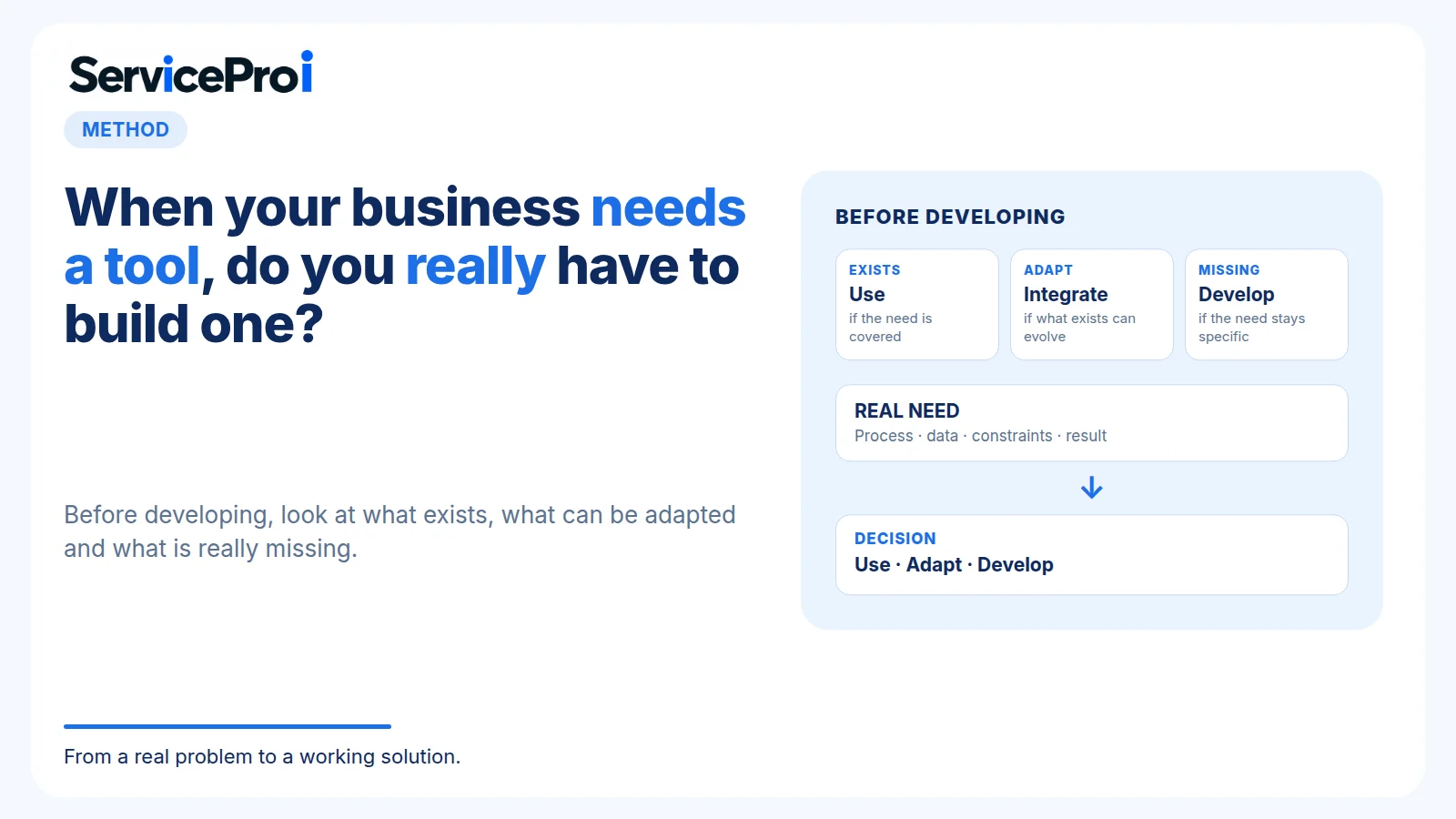
Before developing a tool, look at what exists, what can be adapted and what is really missing. Three possible paths: use, adapt or develop.
We all know the moment when a tool starts to be missing. Information that has to be entered several times. A step that still relies on a spreadsheet. A string of manual steps that takes time. And fairly quickly, an idea appears: "We need a tool for this."
The idea is sometimes right. But it doesn't necessarily mean you have to develop a new tool.
Before building, look at what exists
The custom reflex may seem natural: if the need is special, you need special software. In reality, the first question is often elsewhere: does a solution already exist?
Business software, an online service, a feature that is already available or an open-source tool can sometimes cover most of the need. In that case, developing a whole new solution would mainly add work, maintenance and complexity.
The right tool is not necessarily the one you develop.
Adapt before rebuilding
Between "use as is" and "develop everything", there is a third way: adapt.
That can mean connecting two tools, automating a step, completing a feature, structuring the data or creating a small interface around an existing system.
That is often where the real need appears: not replacing what exists, but making it fit better with the way the business works.
When custom becomes relevant
Specific development obviously has its place when the way the business works cannot be properly covered by available solutions, or when the adaptations needed become more complex than creating a dedicated tool.
But even then, the point is not to develop "because we can". You first need to define what the tool really has to handle, for whom, with what data, what constraints and what expected result.
That work is precisely what turns an idea for a tool into a need you can act on.
Three paths, not a technological religion
Depending on the situation, the answer can be:
- use an existing tool;
- adapt or integrate several solutions;
- develop what is really missing.
These three approaches can even be combined.
At ServiceProI, my principle is simple: start from the real problem, look at what already exists, then decide what really needs to be built. Development only comes after this analysis.
If you know a process is costing you time but you don't yet know which solution would be relevant, describe your situation and we will start from what really happens.
And when the need is clear enough, my packages and prices range from automating a task to building a custom business tool.
From a real problem to a working solution.
Read also: Got an app idea? The 5 questions to ask yourself before you start · A digital solution does not start with technology