
Got an app idea? The 5 questions to ask yourself before you start
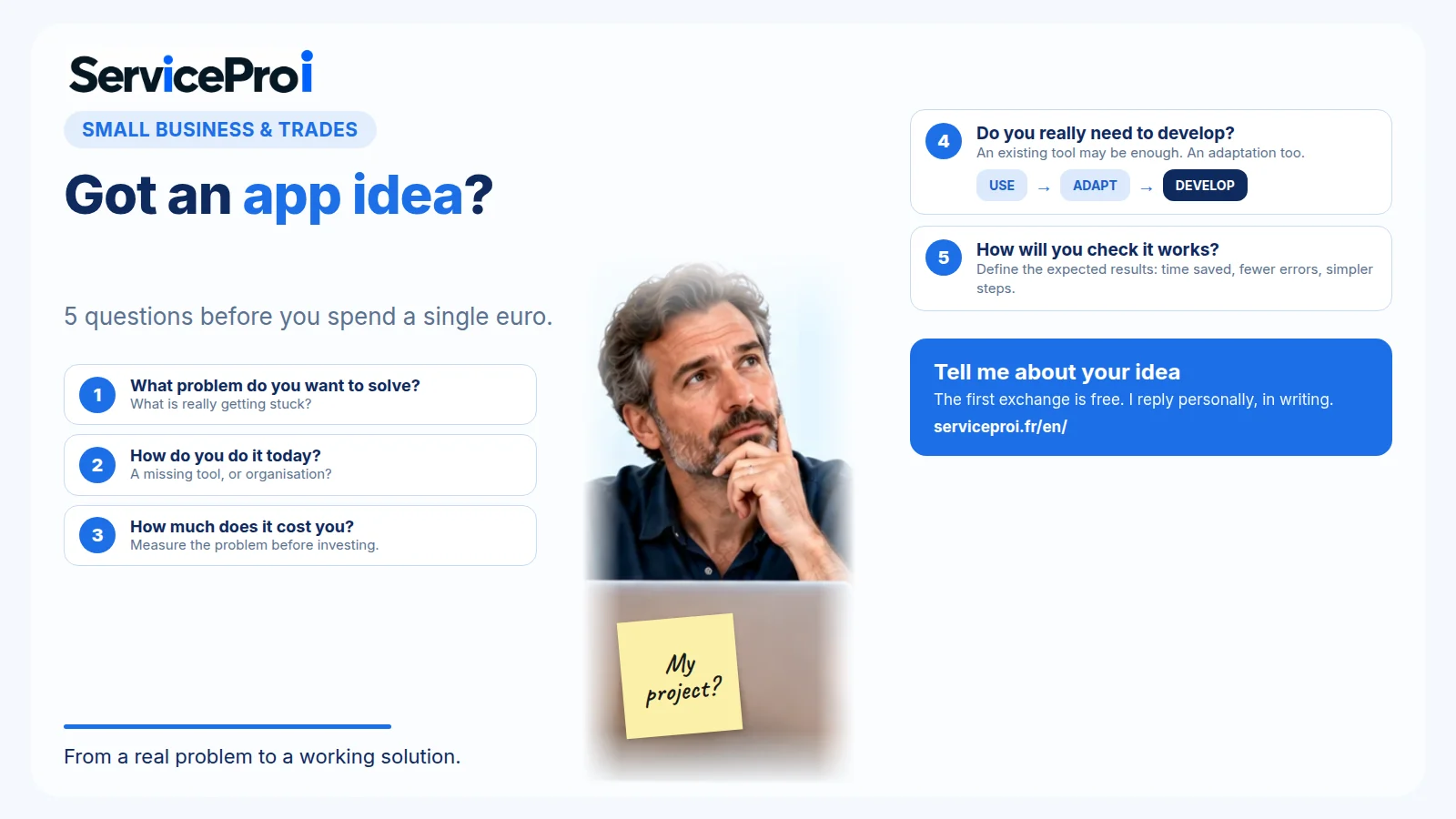
Got an idea for a website, an app or a tool using AI? The five questions to ask yourself before investing, to clarify your need, choose the right approach and check the results.
In short
- Defining the problem before choosing a technology avoids starting on the wrong foot.
- An existing tool or an adaptation may be enough: custom development is not always necessary.
- Measurable goals let you check whether the solution really brings a benefit.
You have an idea for an app. Perhaps you want to simplify your quotes, automate admin tasks, keep better track of your customers or create a tool suited to your business.
You can already picture the features. You may even have picked a technology or asked for a first quote.
But before spending money, one step deserves your attention: checking that you are trying to solve the right problem, with the right solution.
Here are five questions to frame your project before you start.
1. What problem do you really want to solve?
"I'd like an app to manage my quotes" expresses an intention, but doesn't yet define the need precisely.
What is causing you a problem today?
- Writing quotes takes too long?
- The information you need is scattered across several files?
- The calculations are repetitive?
- You forget some follow-ups?
- You find it hard to keep track of the proposals you have sent?
Each difficulty calls for a different answer.
If the problem comes from scattered information, better organisation or a connection between existing tools may be enough. If the calculations rely on specific business rules, custom development may be justified.
The first step is therefore to describe the problem, the people concerned and its consequences for the business.
The principle: don't confuse the solution you imagine with the real need. To go further: building a solution starts with understanding the problem.
2. How do you do it today?
Before designing a new tool, you need to understand how things currently work.
Take a non-profit that wants to automate the preparation of its grant applications.
The work may involve several steps:
- Identify the information needed.
- Find the useful documents.
- Check the data.
- Fill in the forms.
- Have the application approved by the right person.
- Submit everything on time.
Automating the writing will not necessarily solve the difficulties with finding documents or checking.
So you need to reconstruct how the work really flows: the tools used, the information exchanged, the human interventions, the duplicates and the bottlenecks.
This analysis may reveal that the problem is less technical than organisational.
Before building a system, let's understand what it will really have to do.
3. How much does this problem cost you?
An everyday malfunction may seem trivial. Repeated often enough, it becomes a real issue.
Imagine a task that takes 15 minutes and comes up 20 times a week.
The calculation is simple: that is five hours of work a week.
But be careful: those five hours are not automatically a gain you can achieve. A solution may require checks, corrections, maintenance or new manual steps.
To assess whether a project is worthwhile, you need to look at:
- the time spent today;
- how often the task comes up;
- errors and any rework;
- the time that can really be saved;
- the cost of setting up and running the solution.
The cost is not limited to the initial development. You also need to account for hosting, any subscriptions, external services, maintenance and the time needed to learn the tool.
The aim is not to turn every minute into euros. It is to have concrete enough information to decide whether the investment makes sense.
4. Do you really need custom development?
This is an essential question, because several solutions can meet the same need.
At ServiceProI, I use a simple logic: USE → ADAPT → DEVELOP.
Use
An existing tool already meets the need. It just has to be configured and fitted into the way the business works.
Adapt
A solution exists, but it needs adjusting: settings, forms, business rules, automations or data exchanges.
Develop
The need has requirements that available solutions cannot properly meet. Specific development then becomes an option to consider.
This approach does not mean an existing solution is always better. It means you should compare the options before committing (see also: when your business needs a tool, do you really have to build one?).
Custom development can be relevant, but it also brings responsibilities: testing, maintenance, updates and documentation.
The right solution is not necessarily the most sophisticated one. It is the one that meets the need without adding unjustified complexity.
5. How will you know the solution works?
A project should not be considered a success simply because the app opens or the planned features are there.
From the start, you need to define what you want to improve and how you will check the result.
For example:
- Prepare quotes faster: average preparation time;
- Reduce oversights: number of oversights noticed;
- Simplify a procedure: number of steps needed;
- Make customer follow-up easier: time spent looking for information;
- Improve reliability: number of errors detected.
These indicators must be adapted to the situation. The solution also needs to be tested in conditions close to how it will really be used.
Testing helps detect errors, unexpected situations and adjustments needed before rolling it out more widely.
Finally, the people who will use the tool must be able to understand and master it. A solution that works technically but is too complicated to use does not fully meet its goal.
From the imagined project to a working solution
These five questions are not a complete specification. They are a first filter to clarify your project and avoid making technical or budget decisions too early.
At ServiceProI, my approach is to:
- Understand the need and the problem encountered.
- Reconstruct how things really work.
- Look at the tools and solutions already available.
- Define a suitable answer and its scope.
- Estimate the work needed.
- Plan the tests and the acceptance conditions.
The result may be a configuration, an adaptation, an automation or specific development. The analysis may also show that a new tool is not needed.
What matters is being able to explain why a solution is chosen and what it must improve.
You have an idea, but don't know how to make it happen?
Describe it to me in a few lines: the first exchange is free, and I reply personally, in writing.
From a real problem to a working solution.
Digital craftsmanship.
Useful sources (in French)
- France Num: guides and advice on digital strategy: diagnosis and choice of digital actions.
- CNIL: data protection by design: taking data and risks into account from the framing of the project.
These resources support the general approach. The examples of quotes, non-profit applications and time calculations are illustrative and are not customer testimonials.