
Digital sovereignty: freeing small businesses from subscription serfdom
Under the gloss of "digital transformation", many small businesses rent their memory, their processes and a growing share of their margin by the month. Real modernity is not handing everything to SaaS, but taking back control of your data and your tools.
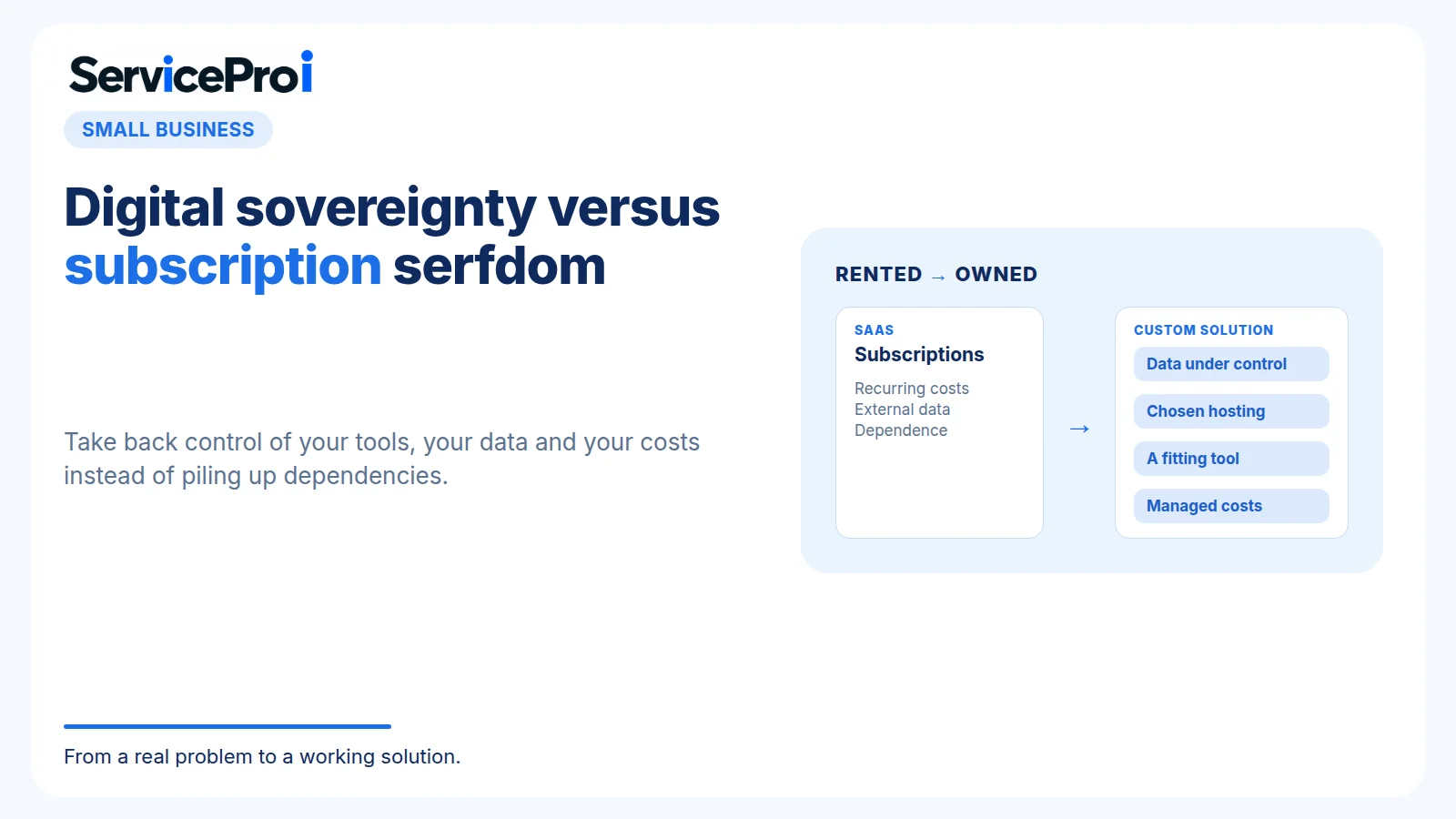
In short
- The "Cloud" is someone else's computer: your tools are rented, not owned.
- Handing your business data to a general-purpose AI means giving away your know-how.
- The alternative: a custom tool, an AI limited to your trade, hosting you control.
There is a fascinating irony in watching today's small business owner: convinced they are at the cutting edge of innovation, they cheerfully sign their own contract of serfdom. Under the reassuring gloss of "digital transformation", the business hands over its memory, its working processes and a growing share of its margin to distant platforms that rent it software black boxes by the month.
We marvel at a general-purpose artificial intelligence able to discourse on ancient philosophy… only to have it write a reminder for an unpaid invoice, calling on transatlantic server farms with a considerable energy footprint along the way.
Depending on the terms of use (often the case with free or consumer offers), the owner even pays for the privilege of training the algorithms with their own data. They expropriate their own added value.
Faced with this financial haemorrhage and this ecological nonsense, real modernity no longer lies in blindly adopting software as a service, but in taking back control. A custom architecture then becomes not a technical whim, but an act of economic self-defence.
The myth of the Cloud and the return of serfdom
The "Cloud" does not exist: it is simply someone else's computer. The consumer SaaS model (Software as a Service) resembles modern digital sharecropping. The small business no longer owns its tools for intellectual work: it rents them.
The entrepreneur now pays a monthly technology tax, which the provider can revise unilaterally. It is a silent drain on cash flow: you subscribe to automate tasks to save time… time that then goes into generating the revenue needed to pay those same subscriptions.
Do the maths: three or four tools at €15 per user per month, for a team of five, add up to several thousand euros a year, without ever owning anything at the end.
Voluntarily giving away your business data
Pouring your customer files, sales history and business rules into general-purpose chat interfaces amounts to working for free for the web giants. The small business offers its intangible capital to a model that may later serve up that refined intelligence… to its own competitors.
It is also a compliance question: customer data entrusted to a third-party service remains your responsibility under data protection law, such as the GDPR in Europe.
Custom architecture as a safeguard
The answer is not to reject AI, but to control how it is integrated. Not every task needs artificial intelligence anyway: classic automation is often enough.
- Localised RAG (Retrieval-Augmented Generation): querying a structured business database with a restricted, controlled model that only answers from your sources. That is the principle of JuriDico, a tool I built that finds official texts and makes every answer verifiable.
- Controlled hosting: deploying your applications, scripts and databases on independent, identified infrastructure, preferably in Europe.
- Investment rather than rent: funding a custom business tool, paid off over several years, rather than piling up perpetual subscriptions.
Refusing off-the-peg algorithms, insisting on your own databases, controlling your own data flows: this means refusing to subsidise technological obesity, and taking back control of your means of production.
Where to start?
There is no need to replace everything at once. Start by listing your subscriptions, the data each one holds and what it would cost you to switch. If your business already relies on a spreadsheet that has become indispensable, that is often the best starting point.
Further reading
- The paperless illusion: handing the admin burden to the algorithm
- Can you leave an AI? Switching tools without starting over
- Packages and prices
Want to know what in your business deserves a tool of your own rather than one more subscription? Describe your situation: I reply personally, in writing.