
Automated customer service: availability without the chatter
Customers expect the responsiveness of a multinational at the price of a local tradesperson. Rather than a chatty chatbot with a made-up first name, a small business needs a system that qualifies requests, answers accurately and prepares the ground for a human.
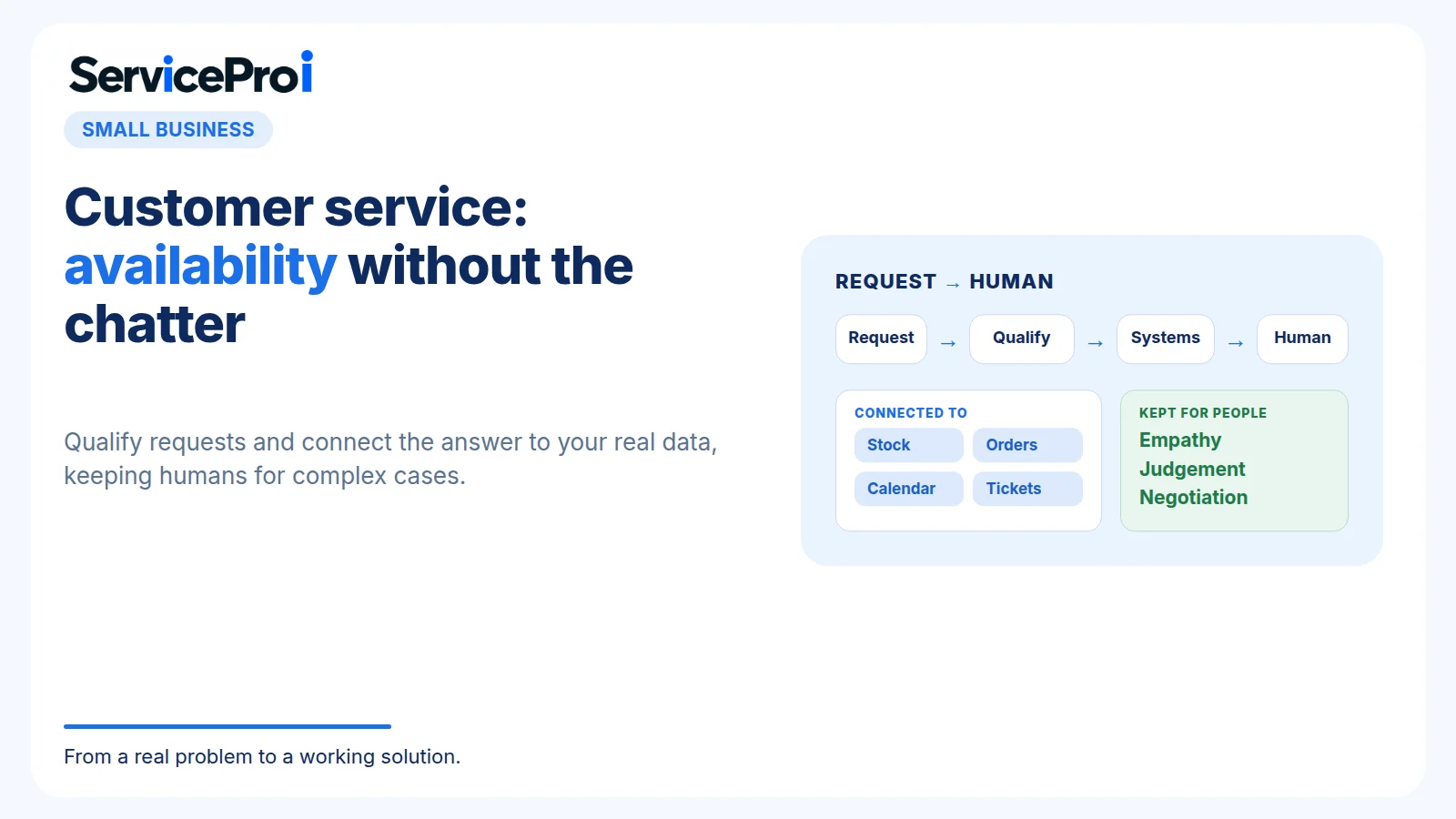
In short
- Customers don't want a virtual friend: they want an accurate answer or an appointment.
- The first job of automation: qualifying requests, not making conversation.
- A useful assistant is connected to your real tools: stock, calendar, job tracking.
The small business owner's dilemma with customers seems impossible to solve: buyers demand the instant responsiveness of a multinational, but are only willing to pay the rate of a local tradesperson.
Interrupting a job or an appointment to answer a standard price enquiry is a management mistake. Letting the phone ring out or replying 24 hours later hands the sale to a faster competitor.
It is tempting to hand your communication channels to a general-purpose chatbot, with an artificial politeness formula and a virtual first name. That is a mistake. Customers are not looking for algorithmic friendship: they want an accurate answer, or an appointment as soon as possible.
Sorting: the algorithm as a noise filter
The first job of automated customer service is not to chat, but to qualify. A large share of requests received by email, form or messaging concern basic information (opening hours, areas covered, indicative prices) or come from browsers with no real project.
Replacing the secretary you don't have with a well-configured qualification workflow lets you handle these requests straight away, without using a second of human time. The AI does not play the poet: it asks the prospect questions, identifies the urgency, checks the fit with your offer, and gathers the technical details needed beforehand (photos, equipment references, location).
If the request is off-target, it receives a polite automatic reply. If it is ready, it lands on your desk, ready to be handled.
First-line support: connecting the assistant to reality
What made most first-generation chatbots useless was their amnesia: unable to consult the company's tools, they kept repeating empty phrases.
Real integration means giving the assistant controlled access to the small business's actual data. That is what agentic AI is about:
- Stock and order status: the assistant queries the management tool directly to give a precise answer ("Your parcel is being prepared", "The part is available at the workshop").
- Booking under constraints: rather than six emails to find a slot, the assistant checks the technician's calendar, takes travel into account and books the time slot directly.
- Structured ticket: in case of a complaint, the assistant does not resolve the crisis on its own; it writes a clear summary for the person in charge.
This information still needs to be available in one place: see Connect your tools.
Transparency: saying it is a machine
An automated assistant must not pass itself off as a human. The European AI Act sets out transparency obligations: people must know they are dealing with an AI system. And the data collected remains subject to data protection law, such as the GDPR.
It is also a matter of trust: a well-informed customer readily accepts a first automatic sort, provided they can reach a human when needed.
Keeping humans for high-value work
The aim is not to dehumanise the business relationship, but to protect it. By handing filtering, data entry and first-line support to predictable software components, the owner and their team only step in where empathy, negotiation and judgement are needed.
When the owner picks up the phone, they are no longer talking to an undecided prospect: they are talking to a customer whose file is qualified, whose need is identified and whose feasibility is confirmed. That is the spirit of SupportSenior, a tool I built where the software prepares the ground and a real person takes over. Likewise, Notipush only alerts you for the messages that really matter.
Automating customer service does not replace the human: it protects their time from the routine of everyday requests.
Further reading
- Customer service and emails: automating customer requests without losing your company's tone
- Survival marketing: automate the form, never the substance
Are customer requests overwhelming you? Describe your situation: we will look at what can be sorted automatically.