
AI: opportunities and risks for small businesses
Artificial intelligence opens up new possibilities for small businesses, but it also carries risks. Its practical uses, the precautions to take and how to choose a solution that fits your business.
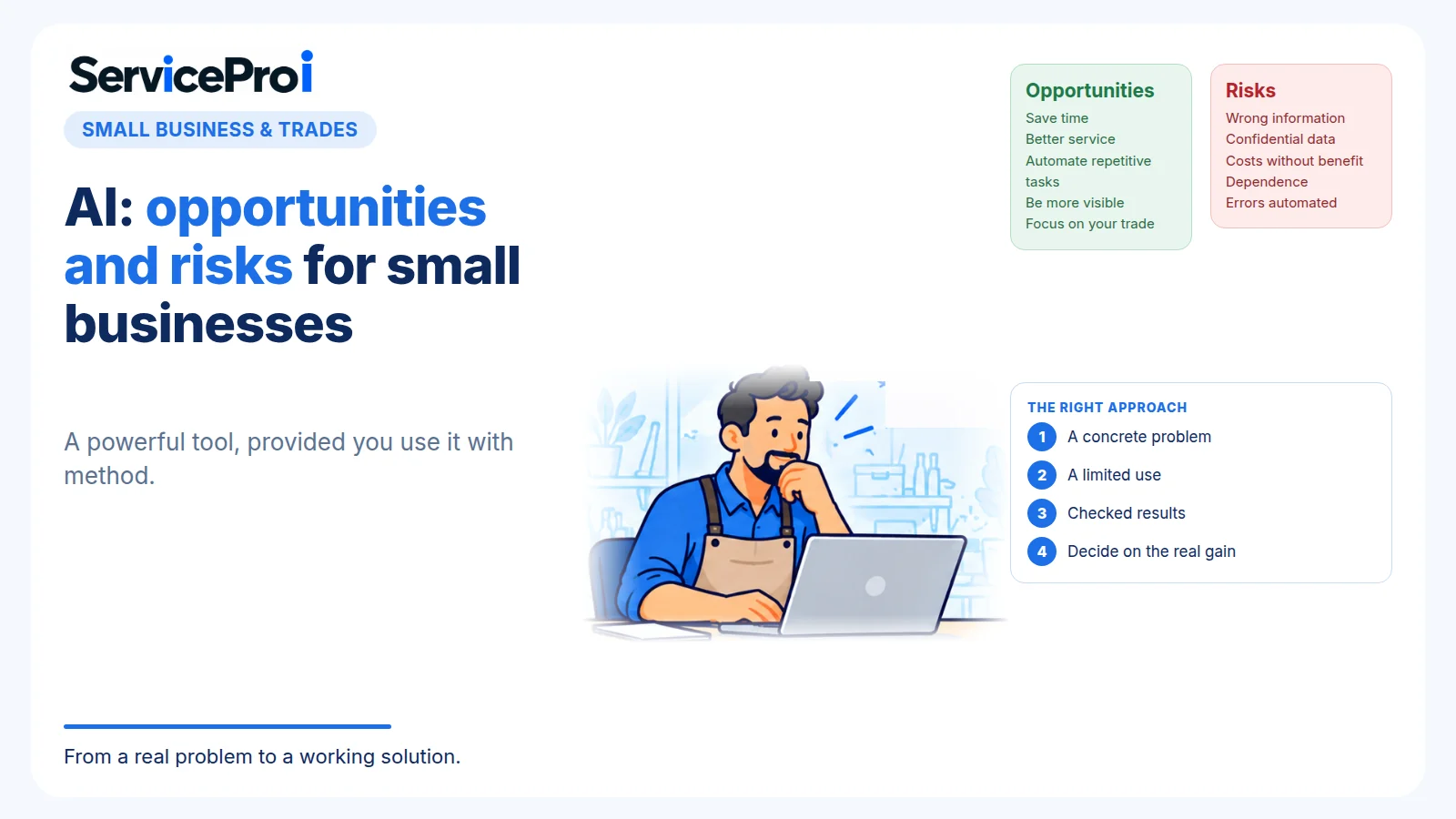
In short
- AI can make some tasks easier and save small businesses time.
- Errors, confidentiality and costs must be kept under control.
- Starting from a concrete need lets you check the real benefit before investing.
Artificial intelligence, and especially generative AI such as ChatGPT, is increasingly present in business tools. Writing, research, document processing, automation: its applications can interest tradespeople, shopkeepers, freelancers and small businesses.
But one question remains: can AI really improve the way a small business works without exposing it to unnecessary risks or adding to its costs?
The answer depends less on the technology chosen than on the problem to solve, the data used and the way the solution is put in place.
1. What opportunities for a small business?
A small business rarely has unlimited resources. The owner has to manage customers, quotes, suppliers, admin and sales. Some repetitive tasks can then take up precious time.
AI can help with several activities.
Preparing replies to customers
An AI tool can prepare a draft reply to a request received by email. The professional reads it, corrects it and approves the message before it is sent.
The potential gain: less time spent writing, while keeping control of the customer relationship.
Making document processing easier
AI can summarise a document, extract information or compare several elements.
A tradesperson could, for example, use it to find the important information in a specification. A non-profit could prepare a first summary of the documents needed for a grant application.
These results must still be checked, especially when the documents contain sensitive information or precise requirements.
Reducing some repetitive tasks
Automations can make it easier to file documents, prepare reminders or pass information between tools.
AI is not always needed: a classic automation rule can be enough if the operations are predictable.
Improving communication
AI can suggest ideas for posts, prepare a first version of an article or adapt content to different formats.
It provides a working base, not necessarily content ready to publish. The professional remains responsible for the accuracy of the information, the tone used and whether the result suits their business.
2. What risks should not be underestimated?
The possibilities are real, but using AI guarantees neither the quality of the result nor the profitability of the project.
Convincing but wrong answers
A generative AI can produce incorrect information, invent a reference or leave out an important element.
In a business context, an error can lead to a wrong answer to a customer, an incorrect quote or an unsuitable decision.
The rule: check important information against reliable sources, and don't mistake a well-worded answer for an accurate one.
Poorly protected confidential data
Copying customer information, contracts or internal documents into a tool without checking its terms of use can expose the business to confidentiality risks.
Before choosing a solution, you need to look in particular at the data sent, how it is used and stored, and the security conditions. Data protection obligations, such as the GDPR in Europe, must also be taken into account.
Spending without real benefit
Piling up subscriptions, adding tools or developing a complex solution does not guarantee a productivity gain.
A task can be automated when it is useless, or an existing tool may already meet the need.
So the overall cost must be assessed: subscription, setup, integration, maintenance, checking results and the time spent learning the tool.
Dependence on poorly understood tools
If nobody understands how an automation works, a change of service, an outage or an error can disrupt the business.
A professional solution must remain understandable, controllable and suited to the business's resources.
3. How to use AI without taking unnecessary risks?
There is no need to transform your whole organisation to get started.
A gradual approach lets you test whether a use is worthwhile before putting more resources into the project.
Step 1: identify a concrete problem
Which task takes too long? Where do things get forgotten? Which information is hard to find? Describe the difficulty before looking for a tool.
Step 2: look at what you already have
Software you already use, a simple rule or better organisation can sometimes solve the problem. AI should not be chosen by default.
Step 3: define a limited scope
Start with a precise task, with data under control and results that are easy to check.
Step 4: plan the checks
Decide what the tool can do on its own, what must be checked, and which decisions remain the responsibility of a person.
Step 5: measure the result
Compare the time saved, any errors, the overall cost and ease of use with the starting situation.
If the benefit is not enough, it is better to correct the approach or give up rather than continue an unjustified investment.
4. Should you automate every task you can?
No. Automation can speed up a faulty process without solving its cause.
Take an example: a business enters the same information several times in different files. It considers using AI to automate this data entry.
Before developing a solution, you need to understand why these duplicates exist. Perhaps a step is unnecessary, an existing tool can already share the data, or a data-entry rule is enough.
The right solution may therefore be to remove a step, adapt the organisation, connect two tools or develop a targeted automation.
AI only comes in if it adds real value.
It is also a question of responsibility: an AI can prepare a proposal, but that doesn't mean it should decide a price on its own, commit to spending or send a document without approval when approval is needed.
5. How I can help
At ServiceProI, my principle is simple: the problem first, the technology second.
The aim is not to add AI everywhere. It is to understand how the business really works, identify the difficulties and look at suitable solutions.
Depending on the need, the answer may be an existing tool, an adaptation, an automation, specific development or a combination of several approaches.
The first exchange is free and without commitment.
Have you spotted a task that costs you time?
Not sure whether AI is the right answer? Describe your situation and I will reply in writing.
Frequently asked questions about the risks of AI in small businesses
Is ChatGPT dangerous for a small business?
Not in itself: the danger comes from how it is used. The main risks are wrong answers presented with confidence, confidential data sent into the tool, and trust given without checking. Used to prepare a draft that a human reads, it carries fewer risks than when it decides alone or handles sensitive documents.
Can you put customer information into a generative AI?
First check the tool's terms of use: what data is sent, how it is used and stored. If in doubt, it is better not to put personal data or confidential documents into it. The French data protection authority (CNIL) publishes a guide on using generative AI in small businesses (see the sources below, in French).
What is the most common mistake?
Choosing the tool before defining the problem. A task can be automated when it is useless, or a tool already in place may be enough. Starting from a concrete need and a limited scope lets you measure the result before investing.
How do you start without taking risks?
Start from a precise task, decide who checks the results, limit the data used and measure the real gain. The detailed steps are in the section "How to use AI without taking unnecessary risks?".
Sources and resources (in French)
- France Num: France Num 2026 barometer.
- CNIL: Using generative AI in small and medium-sized businesses.
- France Num: AI: content generation for small and medium-sized businesses.
From a real problem to a working solution.
Digital craftsmanship.
Read also: AI agents in everyday work: practical solutions for small businesses and tradespeople · Can you leave an AI?