
AI agents for SMEs: what are they for, what do they do around the clock, and where should you stay in control?
An AI agent can reply, sort and follow up at any hour. But what should it do on its own, and what should it hand over to you? Practical uses, limits and supervision.
In short
- An AI agent doesn't just answer: it chains actions (read, sort, reply, create a task) to reach a defined goal.
- Available at any hour, it is useful for the first reply and for sorting, less so for binding decisions.
- It is deployed with a clear scope, written rules and human supervision.
There is more and more talk of "AI agents" for SMEs. Behind the term lies a fairly simple idea: instead of an assistant you ask a question, a program you give a mission, and which chains several actions to carry it out.
Agent, chatbot, assistant: the difference
- A chatbot answers questions, often from scenarios planned in advance.
- An AI assistant (like the ones used for writing) answers when you talk to it.
- An AI agent can also act: check a calendar, search your documents, create a record, send a request for clarification, trigger a task.
It is this ability to act that gives it its value, and that requires it to be kept within bounds.
Practical uses in SMEs
- Handling incoming requests: a visitor writes one evening, the agent gathers their need, asks the useful questions (timing, location, indicative budget) and prepares a record for your team.
- Sorting the inbox: spotting what is urgent, admin or sales, and preparing draft replies.
- Follow-ups: flagging a quote with no answer for ten days and suggesting a message.
- Preparing files: gathering scattered information before a meeting.
See also AI agents in everyday work for small businesses and tradespeople.
"24/7": what it really means
An agent doesn't sleep, which is a real advantage: a request received at 10 pm doesn't wait until the next day for a first reply.
But available doesn't mean competent at everything. At any hour, it must know:
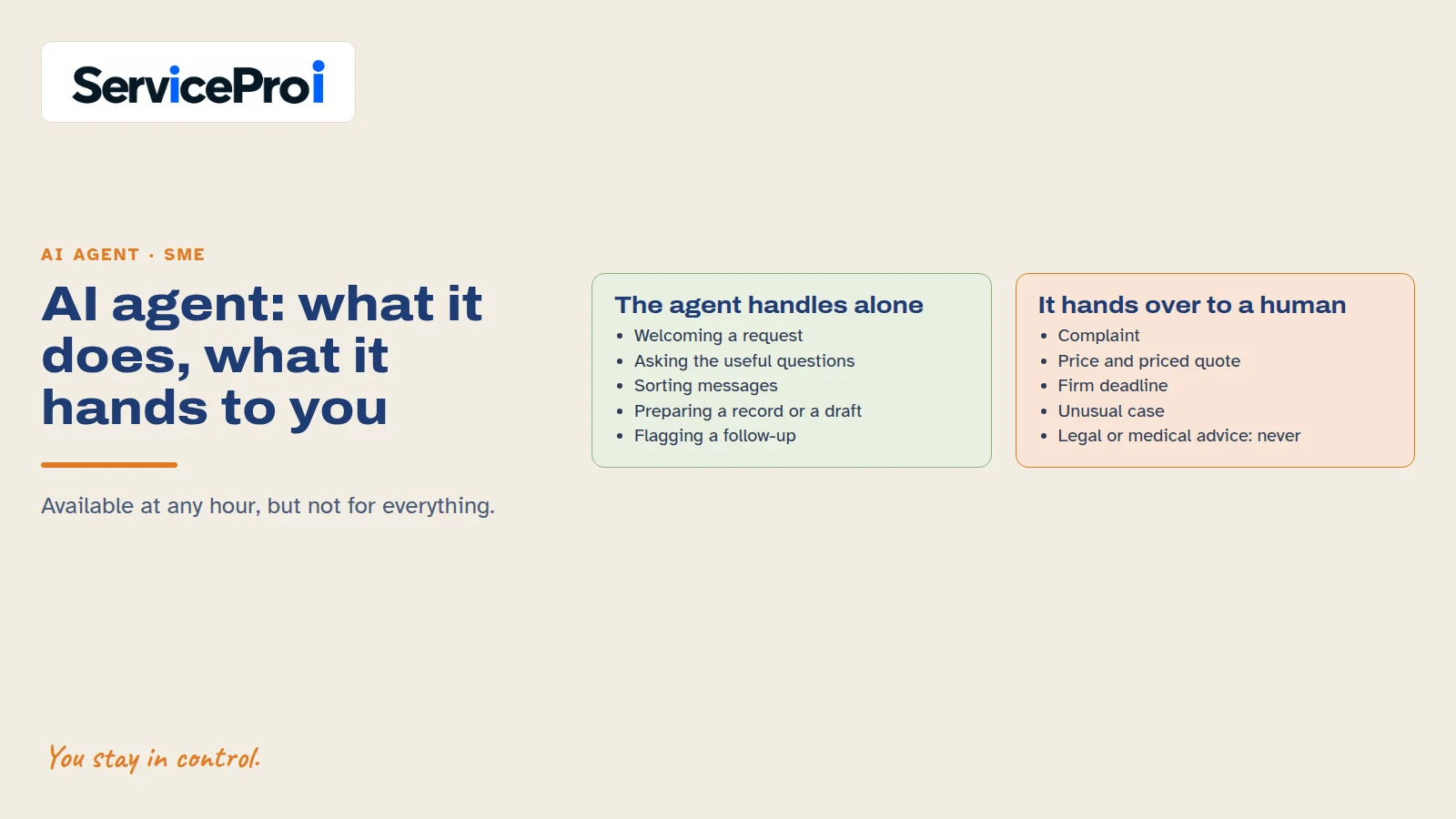
- what it can handle on its own (giving opening hours, collecting a request);
- what it must pass to a human (complaint, priced quote, unusual case);
- what it must never do (commit to a price, promise a deadline, give legal or medical advice).
The limits to know
- It can be wrong, and confidently so. A wrong but well-worded answer is the main risk.
- It only knows what it is given: without up-to-date information on your prices or opening hours, it makes things up or stays vague.
- It has no commercial judgement: a sensitive relationship is handled by a human.
- It can be manipulated: malicious messages may try to make it say or do what it shouldn't.
A wider overview of the risks: AI: opportunities and risks for small businesses.
How to deploy it carefully
- One mission, not ten. Start with a single task (first contact, for example).
- Written rules: what it can say, what it must not say, when it hands over.
- A supervised trial period: you review all its actions for a few weeks.
- A log: being able to find what it did and why.
- An easy off switch: being able to stop it in one move if there is a problem.
How much time does it save?
That depends entirely on the volume of requests and how regular they are. On a low volume, the gain is modest. Be wary of figures with no link to your situation: always ask for a measurement on your real cases.
In summary
An AI agent is a good tool for the front line: welcoming, sorting, preparing. It becomes risky as soon as it is left to decide alone on anything that commits the business. To see what it could look like for you, describe your situation.