
AI in a small business: where to start, good practices and making your team aware
You want to use AI in your small business but don't know where to start? A five-step path, simple rules for the team and the mistakes to avoid.
In short
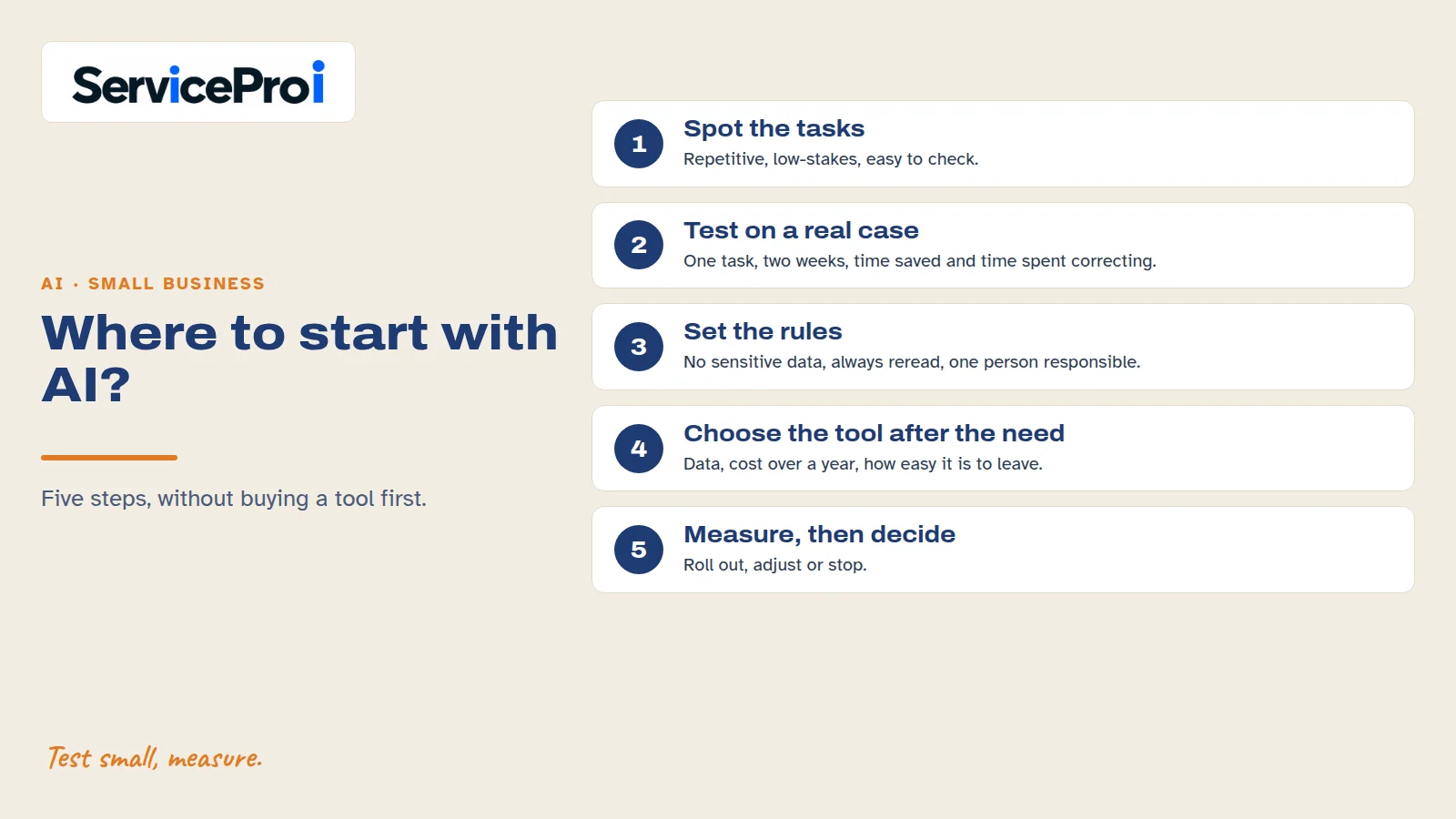
- Start by spotting your repetitive, low-risk tasks, not by choosing a tool.
- A few simple rules, shared by the whole team, avoid most problems (data, checking, responsibility).
- Test on a real case, measure, then decide: don't roll out on a hunch.
"We should get into it." Many small business owners think the same about artificial intelligence, without knowing where to start. Between the tools' promises and the warnings about risks, it is hard to find your way.
Here is a simple path.
Step 1: spot the tasks that lend themselves to it
List what takes up your time every week. Look for tasks that are:
- repetitive (standard replies, meeting notes, formatting);
- low-stakes: an error has no serious consequence;
- checkable: you can quickly judge whether the result is good.
Writing a draft email, summarising a long document, rewording an advert: good candidates. Calculating payroll or answering a complaint alone: avoid to begin with.
Step 2: test on a real case
Take one task and try it for two weeks. Note the time saved, but also the time spent correcting. A tool that produces quickly but badly can cost more than it brings.
Step 3: set rules for the team
Awareness comes through short rules that everyone can understand:
- No sensitive data in a consumer tool: customer contact details, health information, trade secrets, confidential documents.
- Always reread: the AI proposes, a person approves before anything is sent or published.
- Cite your sources: if a piece of information matters, check it elsewhere.
- Say when you used it where relevant (published content, a document given to a customer).
- Know who is responsible: it is always a person, never the tool.
Put them up on the wall, discuss them in a meeting: ten minutes are enough to avoid many mistakes.
Step 4: choose the tool after the need
Once the task is identified, compare a few tools on your cases. Look at:
- how your data is used (is it reused to train the model?);
- location and security;
- the real cost over a year;
- how easy it is to leave: can you get your data back?
Step 5: measure, then decide
At the end of the trial period, answer three questions: is the result reliable? Is the time saving real? Does the team use it willingly? Depending on the answers: roll it out, adjust it, or stop. Stopping is a legitimate decision.
Common mistakes
- Buying a tool before defining the need.
- Trusting without checking, especially for figures, legal references and quotations.
- Banning everything out of fear: your team will then use AI without telling you, with no rules at all.
- Wanting to automate everything at once.
In summary
AI is neither an obligation nor a danger in itself. For a small business, the safest approach is to start from a precise need, test small, set clear rules and measure. To go deeper into the risks, read AI: opportunities and risks for small businesses. To spot where to start, do the quick calculation of repetitive tasks.