
AI agents in everyday work: practical solutions for small businesses and tradespeople
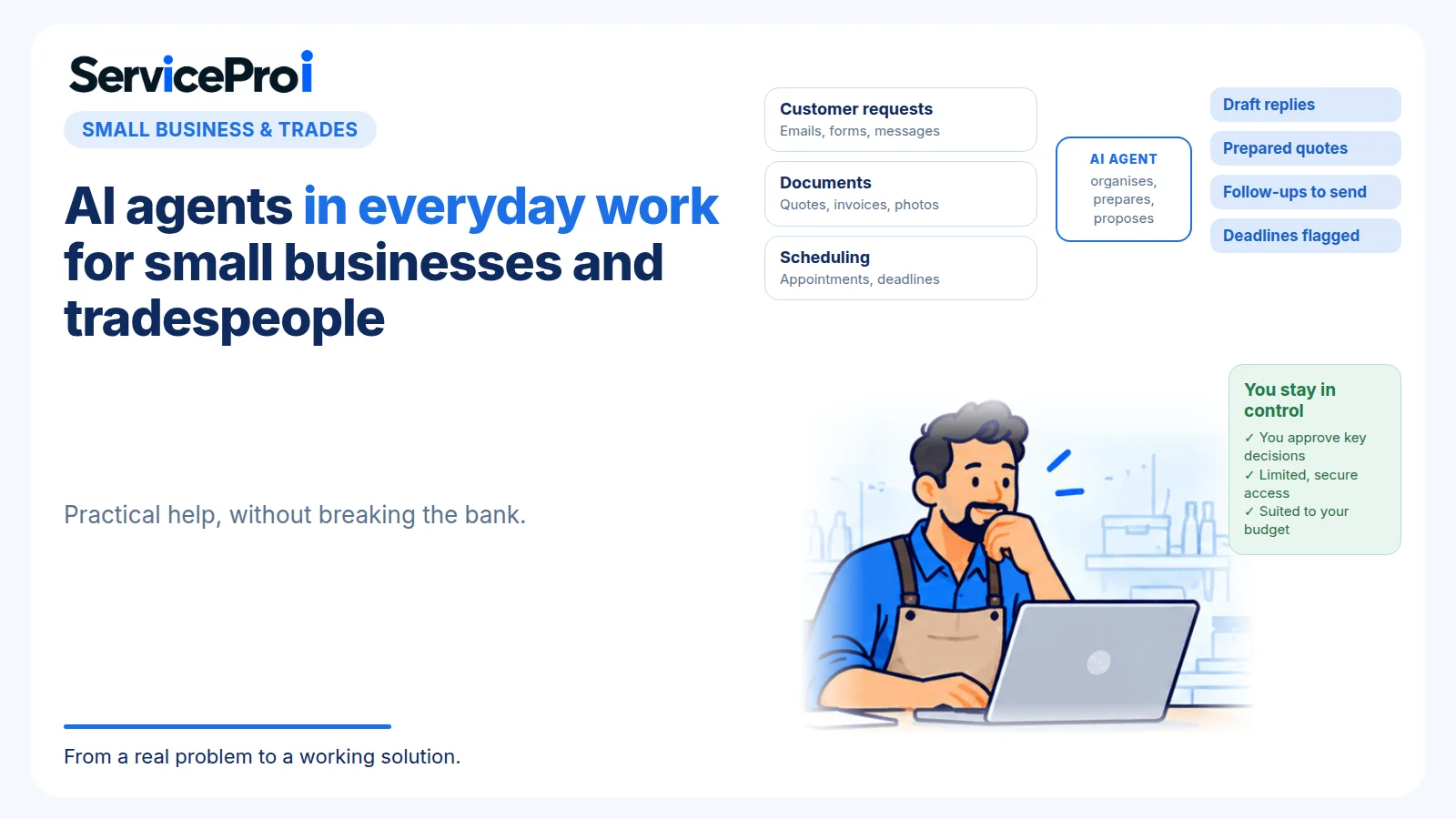
AI agents can help small businesses and tradespeople prepare quotes, handle customer requests and keep track of follow-ups. The difference between a classic AI and an AI agent, everyday examples, and a method to benefit from them without investing in an expensive system.
In short
- An AI agent can chain several actions together to complete a task.
- Quotes, customer requests, follow-ups: the uses are practical.
- Starting small keeps costs under control and lets you measure the benefits.
What is an AI agent actually for?
When you run a small business, time is a scarce resource. Between customers, quotes, invoices, appointments and follow-ups, admin tasks can quickly eat into your core work.
Artificial intelligence can help. But behind this term, often used for everything, you need to distinguish several possibilities.
A classic AI answers a request. An AI agent can organise several actions to reach a goal.
The difference matters: it helps you understand what an agent can really bring to a small business or a tradesperson, without crediting it with abilities it doesn't have.
Classic AI and AI agent: what's the difference?
A classic AI can write a message, analyse a document or answer a question when you ask it to.
An AI agent can go further. Depending on how it is set up, it can chain several steps, use authorised tools and move a task forward towards a defined goal.
Take a simple example.
You receive a quote request by email.
- With a classic AI, you pass it the information and ask it to prepare a draft.
- With an AI agent, the system can spot the request, extract the useful information, organise it, prepare a draft reply and submit it to you for approval.
The agent doesn't do this spontaneously by magic. It has to be given instructions, its access has to be configured and the actions it can carry out have to be defined.
Nor should an AI agent be confused with total autonomy: some agents wait for human approval at each step, while others can carry out certain actions within the limits they are given.
Four practical uses for a small business or a tradesperson
1. Handling customer requests
An agent can help sort incoming requests, identify what they are about and prepare a first reply.
For a tradesperson, this can make it easier to handle enquiries and quote requests. For a small service business, it can help tell urgent requests, routine questions and files needing analysis apart.
The aim is not to reply automatically to everyone. It is to reduce the time spent sorting and preparing replies.
2. Preparing quotes
From the information provided and existing templates, an AI can prepare a draft quote or gather what is needed to put one together.
An agent can organise several steps: retrieve the available information, spot missing data and prepare a document for checking.
Validating the price, the services and the commercial terms must stay under control. A well-presented proposal is not necessarily an accurate one.
3. Keeping track of follow-ups
An agent can spot deadlines, flag customers to chase and prepare a suitable message.
This kind of use is particularly interesting when follow-up still relies on scattered notes, manual reminders or an inbox that is hard to organise.
You still need reliable information and clear rules: who to chase, when, for what reason and with what message?
4. Using documents and preparing communication
An AI can extract information from documents, summarise a file or prepare a post from the elements provided.
An agent can organise these operations and send the results to the authorised tools.
For a small organisation, the benefit is to reduce some repetitive tasks without having to hire or immediately develop specific software.
Not all these uses suit every business. The choice depends in particular on how often the tasks come up, how complex they are, the quality of the data and the tools already in use.
How to use an AI agent without breaking the bank
The right approach is to avoid building a complex system before identifying a precise need.
Step 1: choose a task that really takes time
Start with a repetitive task that is clear enough and whose result can be checked.
For example: preparing replies to routine requests or spotting the follow-ups to send.
Step 2: check whether an existing tool is enough
An AI used occasionally, a feature already available in your software or a simple automation can sometimes meet the need.
A dedicated agent is not always necessary.
Step 3: test on a limited scope
Start with a small number of representative cases. Check the quality of the results, the errors, the interventions needed and the time actually saved.
Step 4: work out the real cost
The cost of an AI agent is not limited to its subscription. It can include setup, connections to your software, maintenance, AI service usage and the time spent checking.
These costs need to be weighed against the benefit obtained.
If a task only comes up twice a month, automating it may not be a priority. If it comes up several times a day, the analysis deserves more attention.
Staying in control: an essential condition
An AI agent can prepare a quote, but it doesn't necessarily have to decide the price on its own. It can write a reply without being allowed to send it. It can extract information without needing access to all of the company's documents.
A few principles are essential:
- limit access to the data needed;
- define precisely which actions are allowed;
- check important information;
- plan human approval for binding decisions;
- protect the confidential data of customers and the business.
The more an agent can act on real systems, the more carefully its permissions and control mechanisms must be defined.
The aim is not to remove all human involvement. It is to focus that involvement where it really adds value.
The right AI agent is the one that meets a real need
There is no need to start with a sophisticated agent connected to all of the company's tools.
It is more useful to identify a task that causes problems, understand how it works and choose the simplest solution that actually improves the result.
Sometimes a classic AI is enough. Sometimes automation is the right fit. Sometimes an AI agent brings real value. And sometimes a tool that already exists meets the need.
At ServiceProI, my approach stays the same:
Understand the need → choose the right solution → build or configure → test → adjust.
Technology is a means, not an end in itself.
Have you spotted a task that costs you time?
Describe it to me in a few lines: I will help you analyse your need and identify a suitable solution.
From a real problem to a working solution.
Digital craftsmanship.
Read also: AI: opportunities and risks for small businesses · Can you leave an AI?